
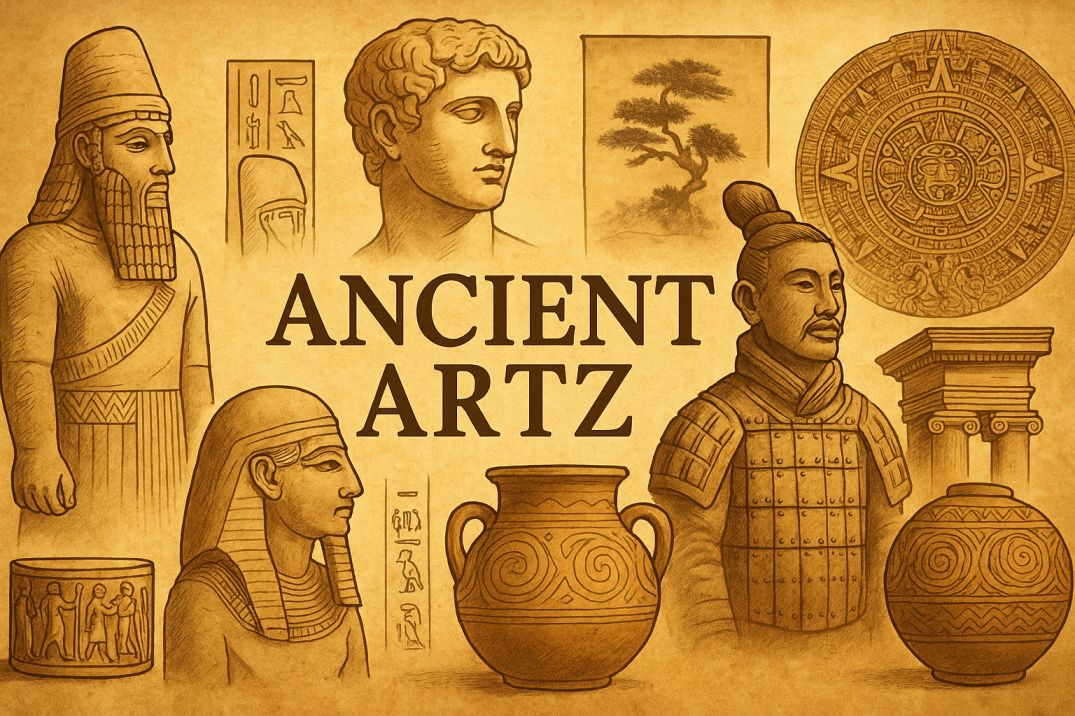
Ancient Artz show the brilliance, faith and creativity of early civilization. Every carved stone, painted wall and molded clay figure carries the dreams, fear and beliefs of the people who shaped our history. Ancient artists did not create for fame or fortune. They created to honor god glorify leader preserve knowledge and celebrate the mysteries of life.
From Mesopotamian carvings to Egyptian tomb mural every piece tell a story. These artworks offer glimpses into ancient daily life religious devotion political struggle and the human desire to understand the universe. Symbol color and materials reveal powerful ideas about creation death nature and the afterlife.
Ancient artwork act as time capsule. They preserve moments, emotions, and philosophies from thousands of years ago. They allow modern people to see through the eyes of distant ancestors and feel their hopes and fears. They connect past and present across time and space.
You should remember that Ancient Artz is not just about beauty. It is about communication, memory, and identity. It proves that creativity and imagination have always been central to the human spirit. Ancient Artz invites every generation to explore where we come from and what it truly means to be human.
The Purpose of Ancient Artz: More Than Beauty
Ancient art was never just for decoration. It served spiritual, political, historical, and practical needs.
It is important to know that each piece had meaning beyond its surface.
Key purposes of Ancient Artz included:
Religious Significance: Depictions of gods, afterlife beliefs, and rituals.
Political Power: Glorifying rulers and intimidating enemies.
Historical Record: Documenting major events and myths.
Practical Use: Pottery tool and textiles with functional design.
Understanding ancient art give insight into how people lived and what they believed.
It is important to know that Mesopotamian art mark the dawn of human creativity. Ancient builder sculptor and craftsmen in this region created some of the earliest known masterpieces. Art in Mesopotamia was deeply tied to religion, governance and everyday life. It reflected the value belief and ambition of powerful early societies that laid the groundwork for future civilization.
Mesopotamia between the Tigris and Euphrates river created some of the first artwork. Sumerian Akkadian Babylonian and Assyrian shaped this early legacy.
Notable features include:
Ziggurat: Huge step pyramid with detailed reliefs.
Cylinder Seal: Tiny carved stone used for stamping document.
Stele: Tall stone slab for law and stories like the Code of Hammurabi.
Kings often appeared larger than others to show divine connection.
Ancient Egyptian Art: Vision of Eternity
It is important to know that Ancient Egyptian art was a bridge between earthly life and the eternal world. Artists create work not only to honor their god but also to ensure the survival of the soul after death. Every sculpture mural and artifact carried deep spiritual meaning. Strong belief and strict artistic conventions kept Egyptian art remarkably consistent over thousand of year.
Egyptian art remain iconic worldwide. Consistency and religious devotion shaped their creations for thousands of years.
Key elements included:
Hieroglyphic: Art combined with writing on tomb and monument.
Funerary Art: Sarcophagi death mask like Tutankhamun and wall painting.
Symbolism: Position, color, and scale indicated spiritual rank.
Egyptians built art to last forever using granite, limestone, and gold.
Greek Art: Realism and Idealism Rise
It is important to know that Greek art shaped the foundation of Western aesthetics through a journey from rigid form to emotional realism. Early Greek artists focused on simple stiff figure that showed limited understanding of human anatomy. Over centuries Greek art developed a deep respect for the beauty of the human body proportion and natural movement. Artists worked to capture the essence of both god and mortal blending physical perfection with spiritual depth.
Greek art evolved across three major period each adding new layer to its legacy. The Archaic Period introduced stiff frontal status like the Kouros, featuring geometric pattern and formal poses. These early work symbolized youth and strength but lacked realistic motion. The Classical Period brought a new focus on balance naturalism and idealized form. Masterpieces like the Discobolus showed athlete in dynamic motion, frozen at the peak of their strength. Sculptor studied muscle structure posture and movement carefully to achieve lifelike representation. The Hellenistic Period shifted again embracing raw emotion drama and complexity. Sculpture like the Laocoön Group depicted suffering and struggle with stunning realism and intensity.
Roman Art: Grandeur with Practicality
It is important to know that Roman art built a bridge between ideal beauty and practical function. Romans admired Greek art and philosophy but chose a more realistic and functional approach. They celebrated human achievements, honored ancestors, and promoted the strength of the empire through their art. Roman artists and architects drew inspiration from Greek ideals but added engineering skill and a focus on realism that made their works unique.
Roman art displayed distinct features that revealed the culture’s values and ambitions. Would you also like a second slightly more vivid option in case you want an even stronger impact? These portraits honored individual legacy and portrayed leadership with honesty. Frescoes and mosaics lit up the wall and floor of villa temple and public bath. They filled Roman spaces with vivid scenes from mythology, daily life, nature, and heroic legends, adding color, story, and spirit to everyday life. Monumental architecture marked Roman achievements with boldness. Builders raised towering arches, strong aqueducts, and massive arenas like the Colosseum, symbols of Roman strength, engineering skill, and community pride.
Roman art served both beauty and propaganda. It reinforced the authority of leaders and promoted Roman ideals throughout the empire. It combined utility with splendor, leaving behind a legacy that still influences modern architecture, sculpture, and urban planning. Through their art, Romans showed that practicality and grandeur could exist side by side, shaping the visual world for centuries to come.
Chinese Ancient Art: Harmony with Spirit
Chinese art spans over 5,000 years, blending nature, philosophy, and reverence.
Famous works included:
The Terracotta Army feature thousand of life size clay soldier created to guard Emperor Qin Shi Huang in the afterlife.
Bronze vessels served in ancestor worship and sacred rituals.
Silk Painting and Calligraphy: Elegant brushwork capturing life flow.
Harmony with nature and respect for ancestors shaped Chinese artistic vision.
Indian Ancient Art: Divine Celebration
Indian art bursts with vibrant details, mythology, and spiritual depth.
Prominent examples included:
-
Ajanta and Ellora Cave: Painted cave with Buddhist and Hindu scene.
-
Deity Sculpture: Expressive figure of god like Shiva and Vishnu.
-
Stupa and Temple: Dome structure housing sacred relic like the Sanchi Stupa.
Indian art connect to divine stories from epics like the Mahabharata and Ramayana.
Pre-Columbian Art: Spiritual Civilizations of the Americas
It is important to know that Pre-Columbian art reveals the spiritual depth and cosmic wisdom of the ancient Americas. Civilization like the Maya Aztec and Inca built rich artistic traditions long before European contact. Their work honored god marked time celebrated ruler and guided daily life. Art was not separate from religion or governance. It was an essential part of how these societies understood their world and maintained social order.
Mayan art feature elaborate carvings and glyph that recorded stories of king battles, ritual and the cosmos. These intricate stone works show how deeply Mayan culture intertwined history with the movement of star and sacred mythologies. The Aztec civilization produced monumental creation like the Sun Stone massive carved calendars that represented celestial cycle divine forces, and the passage of time. These symbol shaped ceremonies agricultural practice and royal power. Inca artisans excelled in textiles and goldwork weaving complex patterns with alpaca wool and crafting delicate metal piece that reflected both skill and spiritual meaning. Their textiles carried code of identity status and religious symbolism.
Pre Columbian art reflect a profound connection to religion astronomy and society. It show how people of the Americas read the skies honored nature and structured their communities. The surviving sculpture mural textile and artifact stand today as a powerful testament to their vision, creativity and understanding of the universe.
African Ancient Art: Deep Symbolism and Spirit
Africa’s ancient artworks from Nubia, Ife, and Benin reveal rich spiritual and social worlds.
Key characteristics included:
Masks and Figures: Vital in rituals and storytelling.
Bronze Casting: The Benin Bronzes remain masterpieces of craftsmanship.
Rock Art: Prehistoric paintings in the Sahara and Southern Africa.
African art embraced community life and sacred traditions through symbolic forms.
Indigenous and Tribal Art: The Hidden Histories
Tribal cultures across Australia, the Arctic, and Pacific Islands shaped unique art traditions.
Examples included:
Aboriginal Dot Paintings: Spiritual maps of Dreamtime journeys.
Inuit Carvings: Animal figures reflecting Arctic life and belief.
These traditions reveal untold stories vital to understanding the global art narrative.
Techniques and Materials in Ancient Artz
Ancient artists were not only skilled but also highly innovative. They mastered material science and tools long before modern technology.
Common materials included:
Stone and Marble
Clay
Gold, Silver, and Bronze
Natural pigments from minerals and plants
Papyrus and Silk
Tools and techniques included:
Chiseling and Carving
Fresco and Encaustic Painting
Lost-Wax Metal Casting
Pottery Glazing and Firing
Ink and Brushwork Calligraphy
Ancient innovations achieved stunning durability and beauty that still survives today.
Symbolism in Ancient Artz
Ancient artists packed layers of meaning into their works.
Common symbols included:
-
Eyes: The Eye of Horus for protection.
-
Animals: Representations of gods and spirits.
-
Circles and Spirals: Signs of life cycles and eternity.
-
Colors: Red symbolized power, blue meant royalty, and gold signified divinity.
Understanding these symbols reveals ancient beliefs and social structures.
Influence of Ancient Artz on Modern Culture
It is important to know that Ancient Artz continue to shape today world in powerful and visible ways. The creative spirit of early civilization still influences art architecture, fashion entertainment and education across the globe. Ancient masterpieces serve as foundation for modern techniques and as source of endless inspiration.
Renaissance artists including Michelangelo and Leonardo da Vinci studied Greek and Roman sculptures and architecture to master human anatomy, perspective and beauty. They revived classical ideal and technique breathing new life into European art and culture. Modern architecture borrows heavily from Roman arche Egyptian column and Greek symmetry. Government building museum and monument often use these ancient design elements to symbolize strength, order, and permanence.
Jewelry and fashion designer find inspiration in ancient African Indian and Chinese motifs. Bold patterns, spiritual symbols, and precious materials from ancient times still appear in modern collections. Cultural heritage becomes a living part of today’s style and identity through these designs.
Pop culture also draw heavily from ancient myths and stories. Movie television show video game and novels often retell the legend of Egypt Greece, Rome and the Americas. Heroes, god monster and sacred quests first imagined by ancient artists continue to thrill and inspire new audiences around the world.
Art schools today still teach ancient methods to help students master form, proportion, balance, and symbolism. These skills, shaped thousands of years ago, remain at the core of artistic education. Ancient techniques guide new generations as they create modern works and honor the wisdom of the past.
Ancient Artz lives on in the buildings we raise, the stories we share, the clothes we design, and the art we imagine. Its influence reminds us that true creativity never fades. It evolves, adapts, and continues to inspire every corner of human culture.
Conclusion
It is important to know that Ancient Artz holds more than historical value. It holds the voices, dreams, and beliefs of people who lived thousands of years ago. Through every sculpture, mural, textile, and carved stone, ancient civilizations left messages meant to endure across time. Their creativity captured not only their world but also their hopes for eternity.
You should remember that in every carved idol, every painted scroll, and every etched stone, ancient voices still speak. They tell stories of devotion, survival, power, and imagination.They show how humans have always searched for meaning, connection, and beauty. Ancient art reminds us that across different languages, lands, and eras, creativity has always bound us together.
Art stands as a universal language. It crosses borders and centuries. It preserves identity, memory, and vision when everything else fades. It teaches new generations about courage, belief, and the endless human spirit.
Ancient Artz proves that creativity is timeless. It shows that humanity has always used imagination to understand life and leave a mark on the world. It still inspires, teaches, and unites us today, keeping the dreams of the past alive in the hearts of the present.